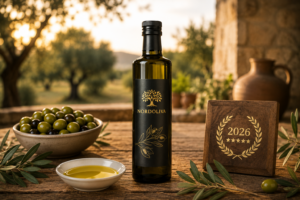
Best Olive Oil 2026: What Consumer Tests Show and How to Find Genuine Quality
The search for the best olive oil 2026 confronts millions of people with the same question: which bottle among the dozens lined up on the supermarket shelf is genuinely good? Germany’s Stiftung Warentest tested 25 products and found only 4 “good”. In the Netherlands, independent laboratory analyses revealed that nearly half of supermarket bottles labelled “extra virgin” did not actually meet that standard.
This article examines both consumer test results and professional sourcing criteria. What lies behind the test numbers, what traps do supermarkets set, and how do you actually find the best olive oil — all explained here.
Best Olive Oil 2026: What Consumer Tests Actually Show
Olive oil quality tests across Europe in 2026 produced striking results. However, they all share the same conclusion: the supermarket olive oil market is struggling with a serious quality problem.
In Germany, Stiftung Warentest tested 25 extra virgin olive oils in January 2026. The result: 4 “good”, 13 “average”, 8 “poor”. Furthermore, not a single product reached the top rating of “very good”. Notably, the results did not correlate simply with price — products priced at €54 per litre frequently landed in the “average” bracket.
In France, 60 Millions de Consommateurs magazine compared 22 extra virgin olive oils. The top position went to a single product from Provence. What set it apart was not its price, but its sensory balance and origin transparency.
In the Netherlands, independent laboratory analyses went further than any single consumer test. Of 15 supermarket bottles labelled “extra virgin”, only 6 actually met that standard. The rest turned out to be lower-grade virgin oil or lampante oil sold under a premium label.
The Critical Blind Spot in Every Consumer Test
All of these tests share one important limitation. They test only products sold in supermarkets, drugstores and discount chains. Not a single direct online producer appears in any of the rankings.
Why does this matter so much? Because supermarket olive oil and olive oil purchased directly from a producer exist in entirely different worlds.
Supermarket products are typically assembled from large bulk batches. Oils from multiple countries are blended together. Harvest dates are frequently absent or vague. Long warehouse storage periods cause gradual quality loss. Moreover, retail chains apply relentless pricing pressure on suppliers — a pressure that consistently produces quality compromises.
Direct-from-producer olive oil, by contrast, offers single-region sourcing, a declared harvest date, full traceability and short supply chains. Consequently, producers like Nordoliva do not appear in Stiftung Warentest or Consumentenbond rankings — not because the quality is lacking, but because the test simply does not reach beyond the supermarket shelf.
Best Olive Oil 2026: The 5 Criteria That Define Genuine Quality
When consumer test methodology and professional sourcing expertise are combined, five criteria emerge as decisive for identifying the best olive oil in 2026.
First criterion: harvest date transparency. The best olive oil always states the harvest year clearly. A product that shows only a best-before date deserves scepticism. Good olive oil should be consumed within 12 to 18 months of harvest. A bottle without a harvest date is concealing when the oil was actually produced.
Second criterion: acid level and analysis document. The legal limit is 0.8%, but genuine quality begins below 0.4%. Premium early-harvest oils typically fall between 0.1% and 0.2%. A trustworthy producer shares a full Certificate of Analysis (COA) on request. This document covers acid level, peroxide value and UV analysis.
Third criterion: single-region declaration. Producers who say “from Edremit” or “from Ayvalık” are far preferable to those who write only “from Turkey” or “product of the EU”. An unspecified origin may indicate blended oil. Single-region production maximises traceability.
Fourth criterion: sensory profile. The best olive oil delivers three characteristic qualities simultaneously: a fresh fruity aroma, balanced bitterness and a burning sensation in the throat lasting several seconds. That burning feeling comes from oleocanthal and is evidence of high polyphenol content. An oil that produces no sensation has either been over-processed or has lost its value over time.
Fifth criterion: packaging quality. Light and oxygen are quality’s enemies. The best olive oil is sold in dark glass bottles or tin containers. Transparent plastic or glass packaging accelerates oxidation, degrading both taste and health value.
Best Olive Oil 2026: Why Turkish Olive Oil Is Gaining Ground
In 2026, Turkish olive oil is increasingly featuring in European best olive oil discussions. The reasons are concrete.
Spain and Italy experienced harvest losses of up to 50% during the drought years of 2022 to 2024. This damaged both price stability and quality across the board. Turkey, by contrast, maintained its production throughout those years and delivered a record harvest in 2024/25. With approximately 450,000 tonnes produced, Turkey became the world’s second-largest producer.
In addition, Turkish olive oils from Edremit, Ayvalık and Milas have been winning gold medals consistently at the Berlin Global Olive Oil Awards, NYIOOC and BIOFACH in recent years. These awards provide independent quality validation that goes beyond any single consumer test.
Furthermore, Turkish olive oil exports to major European markets including Germany and the Netherlands grew by 39% per year between 2020 and 2024. This figure reflects growing confidence among European buyers in Turkish origin as a reliable quality source.
A Practical Checklist: Finding the Best Olive Oil in the Supermarket
If you are shopping in a supermarket, the following checklist will help you make a better choice.
First, read the label carefully. Does it explicitly say “extra virgin”? Products labelled simply “olive oil” do not belong to this category. Is a harvest date or production year stated? If not, subtract 18 months from the best-before date to estimate when it was produced. Is the acid level stated and confirmed below 0.8%?
Second, evaluate the price. Extra virgin products priced below €9 per litre are most likely either blended or of poor quality. All four products that Stiftung Warentest rated “good” cost more than €10 per litre. However, a high price alone is not a quality guarantee — the test also showed expensive products scoring poorly.
Third, examine the bottle. Dark glass or tin? Choose dark glass or tin over transparent plastic or glass. Does it state a shelf life after opening? Store in a cool, dark place and consume within a few months of opening.
Finding the Best Olive Oil 2026 with Nordoliva
The consumer test results make one thing clear: finding genuinely good olive oil on the supermarket shelf is becoming harder every year. However, the solution is straightforward — buy directly from the producer.
At Nordoliva, every bottle clearly states the harvest date, acid level, cold press certification and region of origin. A full Certificate of Analysis is available on request for every batch. For individual orders, visit our product page. For wholesale purchasing and importer partnerships, fill out our contact form — our team responds within 24 hours.
For your next step, read our article “What Is Extra Virgin Olive Oil? A Label Reading Guide” → Nordoliva Blog
Sources: Stiftung Warentest — Olivenöl Test 2026 | International Olive Council (IOC)
Bir yanıt yazın