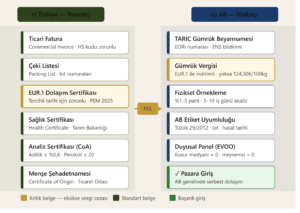
Olive oil import volumes from Turkey to Europe grew 39% annually between 2020 and 2024. Over the same period, export value increased by 85%. Consequently, Turkey has moved to the center of the olive oil import strategy for European distributors. However, the process requires careful preparation in terms of EU customs regulations, mandatory documents, and quality standards. In short, understanding the olive oil import process is essential before placing your first order from Turkey.
This guide covers the olive oil import process from start to finish. It includes customs tariffs, mandatory documents, quality standards, and common mistakes. It is particularly aimed at distributors, importers, and retail chains sourcing olive oil from Turkey for the first time.
1. Turkey–EU Customs Framework: The Basics
Turkey has been part of a Customs Union with the EU since 1995. However, this union covers only industrial goods and processed agricultural products. Raw agricultural products such as olive oil fall outside the Customs Union. Therefore, these products are governed by a separate free trade agreement.
For importers, this means the following in practice: to benefit from customs duty exemptions, the correct origin documents must be prepared. Otherwise, standard duty rates apply in full.
Applicable Customs Tariff (TARIC)
You can verify EU duty rates for Turkish-origin olive oil via the TARIC database. The table below serves as an initial reference:
| Product Type | CN Code | Standard Duty |
|---|---|---|
| Extra virgin olive oil (< 5 litre) | 1509 2000 10 | €124.50 / 100 kg |
| Extra virgin olive oil (bulk) | 1509 2000 90 | €124.50 / 100 kg |
| Virgin olive oil | 1509 3000 | €124.50 / 100 kg |
| Table olives (salted) | 2005 70 | 20% |
The EUR.1 movement certificate is mandatory to access preferential tariff rates. In other words, without EUR.1 you pay full duty on every kilogram. However, obtaining this certificate is straightforward when working with an experienced exporter.
2. Olive Oil Import Documents: Complete Checklist
The standard document set for olive oil import from Turkey consists of nine documents. A missing or incorrect document can cause customs delays, product returns, or seizure. Therefore, verify every document before shipment. In practice, most delays occur because of lot number mismatches or missing health certificates. Therefore, build a pre-shipment checklist and share it with your supplier.
A) Commercial Documents
1. Commercial Invoice
The invoice must contain complete information. First, it must include full seller and buyer details and a complete product description (type, acidity, harvest year). In addition, the HS code, Incoterms (EXW, FOB, CIF etc.), and payment terms are mandatory.
2. Packing List
In addition to the invoice, the packing list is also mandatory. It must contain packaging details, batch/lot numbers, and the container number. Furthermore, the lot number must match the health certificate exactly.
3. Bill of Lading or CMR
The required document depends on the transport mode. For sea freight, an original bill of lading (3 copies) is required. For road transport, a CMR document is needed instead.
B) Origin and Customs Documents
4. EUR.1 Movement Certificate
In the olive oil import process, EUR.1 is the most critical document. It is mandatory to access preferential tariff rates between Turkey and the EU. Moreover, EUR.1 conditions were updated under the revised PEM Convention that entered into force in 2025. Therefore, make sure you are using the current version. For more information, visit the EU Access2Markets portal.
5. ATR Movement Certificate
This document covers processed products within the Turkey–EU Customs Union scope. While it does not apply to raw olive oil, it may be required for some processed olive oil products.
C) Food Safety and Quality Documents
6. Health Certificate
The EU requires a health certificate from the competent authority of the exporting country. For Turkish-origin products, the Ministry of Agriculture and Forestry issues this document.
7. Certificate of Analysis (CoA)
This certificate must be issued separately for each batch. It must cover free fatty acid content (max. 0.8% for EVOO), peroxide value (max. 20 meq O₂/kg), UV absorbance (K232, K270), organoleptic test results, pesticide residue, and heavy metal analysis. Furthermore, if any parameter falls outside its limit, the product cannot be sold as extra virgin in the EU.
8. Certificate of Origin
The exporting company prepares this document. The Chamber of Commerce or relevant authority then approves it. In addition to EUR.1, some EU customs offices may also request this document.
D) Labelling Compliance
9. EU Label Compliance Declaration
Under EU Regulation No 29/2012 and Commission Delegated Regulation (EU) 2022/2104, olive oil labels must contain six mandatory items. These are: product category, country of origin, harvest date or best before date, net quantity, producer/filler information, and lot number.
3. EU Olive Oil Quality Standards
The EU makes both physicochemical and sensory standards mandatory for olive oil imports. If your product does not meet these thresholds, you cannot use the “extra virgin” label. Consequently, you cannot enter the premium market.
Physicochemical Standards (EVOO)
| Parameter | EU Limit |
|---|---|
| Free fatty acidity | ≤ 0.8 g / 100 g (oleic acid) |
| Peroxide value | ≤ 20 meq O₂ / kg |
| K270 (UV absorbance) | ≤ 0.22 |
| K232 | ≤ 2.50 |
| ΔK | ≤ 0.01 |
In addition to the chemical limits above, sensory evaluation is equally important. As a result, buyers should always request organoleptic test results alongside the CoA.
Sensory Evaluation (Organoleptic Test)
EU regulations determine the extra virgin category through an official sensory panel of trained panellists. The median defect score must be zero. Furthermore, the median fruitiness score must be greater than zero. Otherwise, the product cannot be labelled as “extra virgin.” As a result, failing the sensory panel means direct product rejection in the EU.
4. Olive Oil Import Steps: From Start to Finish
Step 1: Supplier Selection and Pre-Verification
Selecting the right supplier is the most critical phase of the olive oil import process. Therefore, request ISO 22000, HACCP, and organic certificates. Also, arrange a factory visit or virtual tour and review previous batch analysis reports. For example, working with Nordoliva — an experienced EU exporter — significantly simplifies the documentation process. In summary, the more documentation you request upfront, the fewer surprises you face at customs. Review our product portfolio and certificates here.
Step 2: Sample and Laboratory Analysis
First, request a sample before placing a formal order. Then have it analysed at an accredited laboratory (SGS, Bureau Veritas, Intertek etc.) and complete the sensory panel test. Indeed, buyers who skip this step frequently face product rejection at customs.
Step 3: Contract and Payment
First, determine whether CIF or FOB delivery terms apply. In addition, clarify L/C or T/T payment terms. Finally, include quality guarantees and return conditions in the contract.
Step 4: Document Preparation
Check that all documents are ready before shipment. Specifically, the set must include: EUR.1 approved by Turkish customs, a health certificate from the Turkish Ministry of Agriculture, an accredited laboratory CoA, and the commercial invoice, packing list, and bill of lading.
Step 5: Customs Declaration (EU Side)
First, verify that your EORI number is active. Then submit the pre-arrival ENS (Entry Summary Declaration) using the correct TARIC code. Finally, deposit the required customs duty guarantee.
Step 6: Physical and Document Inspection
EU customs authorities conduct document checks on every batch. In addition, they may carry out physical sampling at a rate of 1–5%. Sample analysis takes approximately 5–10 working days. Therefore, account for this delay in your financial planning.
5. Common Mistakes and Their Consequences
Below are the four most common mistakes drawn from real customs cases. Although these mistakes seem avoidable, they account for the majority of customs delays in olive oil import shipments.
Mistake 1: Lot number mismatch
If the lot number on the health certificate does not match the packaging, the entire batch is held at customs. Moreover, storage costs are charged to the importer.
Mistake 2: Failing the extra virgin standard
Olive oil that fails the sensory panel or has acidity above 0.8% cannot be sold as extra virgin. Consequently, the product is destroyed or returned after customs inspection.
Mistake 3: Shipment without EUR.1
Without EUR.1, the preferential tariff does not apply. As a result, the standard duty of €124.50 per 100 kg applies. For large container loads, this difference can reach tens of thousands of euros.
Mistake 4: Missing label information
EU regulations require the harvest date, country of origin, and lot number on the label. Therefore, a missing label completely blocks the product from entering the market.
6. Simplify Your Olive Oil Import Process with Nordoliva
At Nordoliva, we prepare all export documents completely and on time. Furthermore, we carry out independent laboratory analysis for every batch. As a result, buyers who work with Nordoliva typically clear customs without delays or additional costs. Specifically, the EUR.1 movement certificate is provided as standard with every shipment. In addition, each batch includes an accredited CoA, a Ministry-approved health certificate, current ISO 22000, HACCP and Organic certificates, and EU-compliant labelling with private label options available.
Use our contact form to request container-based wholesale pricing and sample documents.
Bir yanıt yazın