Stiftung Warentest 2026: Only 4 of 25 Olive Oils Rated “Good” — How to Choose a Genuinely Quality Olive Oil
Germany’s most trusted consumer testing organisation, Stiftung Warentest, published its olive oil quality test results in January 2026. The findings were stark: of 25 extra virgin olive oils tested, only 4 received a “good” rating. Moreover, 8 products were rated “poor” — including well-known discount brands and even some labelled as organic.
The results shook both consumers and professional buyers. However, behind those numbers lies a critical detail that most headlines missed — and understanding it completely changes how you should approach olive oil selection.
Olive Oil Quality Test 2026: What the Results Actually Showed
Stiftung Warentest evaluated each product across five criteria. Sensory analysis carried the highest weight at 50%, followed by contaminants at 20%, labelling accuracy at 15%, chemical quality at 10%, and packaging at 5%.
The outcome was clear. Four products received a “good” rating, thirteen landed in the middle tier, and eight were rated “poor”. Furthermore, not a single product achieved the top rating of “very good”. The four products that passed all had one thing in common: they all cost more than €10 per litre. Meanwhile, several products priced under €9 per litre failed the test entirely.
Stiftung Warentest summarised the situation bluntly. Climate change is damaging olive harvests across the Mediterranean, and the relentless pricing pressure from retail chains is pushing quality even lower.
The Critical Detail Most Buyers Miss
Here is the finding that changes everything. Stiftung Warentest tests only products sold in supermarkets, drugstores and discount chains. Not a single direct online producer appeared in the test.
Why does this matter so much? Because supermarket olive oil and olive oil sourced directly from a producer operate in entirely different worlds.
Supermarket products are typically assembled from large bulk batches. Oils from multiple countries are blended together. Harvest dates are often absent or vague. Long warehouse storage periods cause gradual quality loss. Furthermore, retail chains place enormous cost pressure on suppliers — a pressure that consistently translates into quality compromise.
Direct-from-producer olive oil, by contrast, offers single-region sourcing, a declared harvest date, full traceability and short supply chains. Consequently, producers like Nordoliva do not appear in the Stiftung Warentest rankings — not because the quality is lacking, but because the test does not reach beyond the supermarket shelf.
Olive Oil Quality Test Criteria: How Nordoliva Measures Up
The Stiftung Warentest criteria are actually a useful framework for evaluating any olive oil. So let us walk through each one.
Sensory Analysis — Aroma, Taste and Profile
Genuine extra virgin olive oil should deliver a fresh fruity aroma, balanced bitterness and a peppery burning sensation in the throat. These qualities come directly from oleocanthal and oleuropein — the polyphenols that define both flavour and health value. Nordoliva’s early-harvest oils from the Edremit region carry all three attributes. The reason is straightforward: early harvest, cold pressing below 27°C, and processing within four hours of picking.
Contaminant Testing — Pesticides and Mineral Oils
Nordoliva commissions independent laboratory analysis for every batch. These analyses cover pesticide residues, mineral oil components (MOSH/MOAH) and UV absorbance testing. The results are available on request for any buyer.
Labelling Accuracy
Every Nordoliva bottle clearly states the harvest date, acid level, region of origin and cold press certification. There is no vague or misleading information — what the label says is what the bottle contains.
Chemical Quality — Acid Level and Peroxide Value
Our acid level consistently falls well below the 0.8% legal limit, typically reaching 0.2% or lower. Peroxide value is maintained below 12 meq O₂/kg, confirming freshness and minimal oxidation.
Packaging
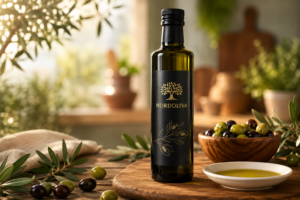
Dark glass bottles or tin cans are used to protect polyphenols from light and oxygen. Clear plastic or glass packaging is avoided, as it accelerates oxidation significantly.
Why Do So Many Products Fail the Olive Oil Quality Test?
The answer comes down to three structural problems in the supermarket olive oil supply chain.
The first is climate-driven quality decline. Spain and Italy — the dominant suppliers to European supermarkets — suffered severe drought conditions between 2022 and 2024. As a result, olive harvests deteriorated sharply. Turkey, by contrast, maintained its production through those years and delivered a record harvest in 2024/25.
The second is retail pricing pressure. Supermarket chains fix shelf prices and push suppliers to match them regardless of harvest conditions. Consequently, when raw material costs rise, quality is often the first casualty.
The third is blending and opacity. Most large brands blend oils from multiple countries. This means traceability disappears almost entirely. A bottle labelled “product of the European Union” could contain oils from five different harvests in four different countries.
A Practical Checklist: How to Evaluate Any Olive Oil
Drawing on the Stiftung Warentest methodology, here is a straightforward checklist for any serious buyer.
First, check the harvest date. Is it clearly stated on the label? If only a best-before date appears, count back 18 months to estimate the production year. Consume within 12 to 18 months of harvest.
Second, check the acid level. The legal limit is 0.8%, but genuine quality starts below 0.4%. Premium single-origin oils typically fall between 0.1% and 0.2%.
Third, request an analysis report. A trustworthy producer shares both acidity and contaminant analysis results without hesitation. If a producer cannot provide this, treat it as a warning sign.
Fourth, look for a single-region declaration. “From Edremit” or “from Ayvalık” is far more reassuring than “from Turkey” or “product of the EU”. A specific region indicates a specific harvest and a specific producer.
Fifth, apply the taste test. Warm a small amount in your palm, then sip and swallow. A peppery burning sensation in the throat that lasts a few seconds confirms high polyphenol content. An oil that delivers no sensation at all has likely been over-processed or has lost its value with age.
Why the Stiftung Warentest Results Actually Benefit Direct-Source Buyers
The test results carry an unexpected silver lining for buyers willing to look beyond the supermarket shelf. They confirm that quality olive oil cannot be produced cheaply and sold cheaply. Therefore, the four products that passed all cost more than €10 per litre. They also confirm that brand names and organic labels alone are not reliable guarantees of quality.
This shifts the argument firmly in favour of direct sourcing. When you buy from a producer who controls the harvest, the pressing and the bottling, you remove the variables that cause supermarket products to fail. Furthermore, you gain access to the information that Stiftung Warentest measures: sensory quality, contaminant data and labelling accuracy.
Sourcing Genuinely Quality Olive Oil with Nordoliva
The Stiftung Warentest results make one thing clear: finding a genuinely good olive oil on the supermarket shelf is becoming increasingly difficult. However, the solution is straightforward — buy directly from the producer.
At Nordoliva, every bottle carries a declared harvest date, acid level, cold press certification and region of origin. Analysis reports are available on request for every batch. For individual orders, visit our product page. For wholesale purchasing, importer partnerships and private label enquiries, fill out our contact form — our team responds within 24 hours.
For your next step, read our article “Turkish Olive Oil: Why Is It So Good? A Complete Buyer’s Guide” → Nordoliva Blog
Sources: Stiftung Warentest — Olivenöl Test 2026 | International Olive Council (IOC)