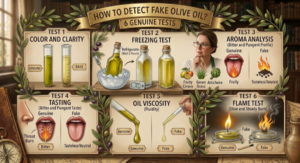
How to Spot Fake Olive Oil: 6 Real Tests
Are you sure you are getting what you pay for? A significant portion of olive oils sold on shelves are either diluted with refined oil or blended with other vegetable oils. Furthermore, some have been sitting on the shelf far longer than you might expect. That is why millions of people search for how to spot fake olive oil every single year.
In this guide, we cover 6 real tests you can apply at home. In addition, we debunk the most common myths with scientific context. After reading this, you will not be misled again.
What Does Fake Olive Oil Actually Mean?
When people say fake olive oil, two situations come to mind. First, the bottle may contain non-olive vegetable oils such as sunflower, corn or soya. Second, the oil may technically be olive oil — however, it is labelled as “extra virgin” while actually being refined or very low quality.
Both situations damage the consumer financially and physically. Unfortunately, simple home tests cannot detect either situation with certainty. As a result, the only definitive answer comes from a laboratory analysis. That said, the tests below will give you strong and reliable clues.
Fake Olive Oil Test 1 — Taste: The Most Reliable Home Method
The International Olive Council (IOC) uses sensory analysis as the primary basis for classifying olive oil. Therefore, the taste test is the most reliable method you can try at home.
How to do it
Pour a small amount into a glass. Warm it in your palm. Inhale the aroma. Then take a small sip, move it across your tongue and swallow.
What should you feel?
First, a fresh fruity aroma arrives. Next, a slight bitterness appears on the sides of your tongue. Finally, a peppery burning sensation hits the back of your throat. This sensation is proof of oleocanthal — a powerful anti-inflammatory antioxidant. Moreover, the more pronounced the burn, the higher the polyphenol content.
In fake or low-quality oil, by contrast, you feel nothing. The oil is bland and neutral. In some cases, a paint-like or rancid smell is also noticeable.
Important: The burn must stay in your throat. If it travels to your stomach, the oil has likely gone rancid or carries a very high acid level.
Fake Olive Oil Test 2 — Smell: Your Nose Will Not Lie
Olive oil is technically a fruit juice. As a result, genuine fresh olive oil should smell fruity, green and vibrant.
Real extra virgin olive oil reminds you of freshly cut grass, green tomato leaves, artichoke or fresh almonds. Fake or spoiled oil, on the other hand, smells of paint thinner, mould, mustiness or rancid fat. If you detect any of these, do not buy the bottle.
To make this test more effective, warm the glass in your palm first. Heat releases the aromatic compounds and makes the difference much easier to detect.
Fake Olive Oil Test 3 — Refrigerator: Half True, Half Myth
This is the most widely shared test online. “Put it in the fridge — if it solidifies it is real, if it stays liquid it is fake.” However, the reality is more nuanced than that.
Here is what the science says: Olive oil is primarily composed of monounsaturated fatty acids. These begin to crystallise at around 4–7°C and turn cloudy within 30–45 minutes.
What to look for
If the oil solidifies completely and uniformly with a matte appearance, this is a positive sign. If, however, part of the oil solidifies while the rest stays liquid forming two distinct layers, another oil may have been blended in.
That said, some genuine olive oils do not solidify in the fridge. This is because the fatty acid profile varies by variety and harvest time. Therefore, never use this test alone. Always combine it with the taste and smell tests.
Fake Olive Oil Test 4 — Price: The Cheapest Bottle Is a Warning Sign
This is one of the least used but most reliable indicators. Producing high-quality extra virgin olive oil is genuinely costly. Early harvest, cold pressing, low yield and careful handling all directly affect the price.
Very cheap olive oils are most likely in one of three groups: diluted with refined oil, blended with other vegetable oils, or left sitting so long they have lost all value. Of course, an expensive price alone does not guarantee quality either. Nevertheless, an unusually low price for extra virgin olive oil is always worth questioning.
Fake Olive Oil Test 5 — Label: Learn to Read the Bottle
The label is the most systematic way to identify fake olive oil. All of the following must appear clearly on the label.
“Extra Virgin Olive Oil” stated explicitly: products labelled simply “olive oil” do not belong to this category. Acid level below 0.8%: in premium products it falls between 0.1–0.4%. Harvest or bottling date: without this, you cannot know when the oil was produced. Origin information: the region and ideally the specific estate. Cold press indication: if stated, the producer guarantees no heat treatment was applied.
Furthermore, brands that provide a QR code linking to a laboratory analysis report are proving their transparency. Be cautious with products that use only vague terms like “natural” or “farm product” without any supporting data.
Fake Olive Oil Test 6 — Certificate and Lab Report
A trustworthy producer tests its product in an independent laboratory and shares the results publicly. This is, in fact, the most definitive way to identify fake olive oil.
Key documents to look for: acidity analysis below 0.8%, peroxide value below 12 meq O₂/kg, UV spectrophotometric analysis for adulteration detection, fatty acid profile analysis to check for blended oils, and an organoleptic panel report from trained tasters.
Stay away from producers who cannot provide these documents. A genuinely trustworthy brand answers every question about its product with complete transparency.
3 Common Myths: Stop Believing These
A great deal of misinformation about fake olive oil circulates online. Here are the three most important myths to ignore.
“Green means real — yellow means fake.”
This is completely wrong. Colour depends on harvest time and olive variety. Early harvest oils are green. Late harvest oils are golden yellow. In fact, both can be genuine and high quality. Never judge by colour alone.
“If it bubbles in water, it is real.”
This test has no scientific validity. All oils are hydrophobic and float on water. It is not possible to tell fake olive oil from real olive oil using this method.
“Olive oil that does not solidify in the fridge is fake.”
As explained above, solidification depends on the fatty acid profile and varies by variety. Consequently, some genuine oils simply do not solidify. This is not a sign of adulteration.
Conclusion: How to Spot Fake Olive Oil — The Most Reliable Answer
The honest answer to how to spot fake olive oil is this: home tests provide useful clues. However, they cannot give definitive results. The only true method for detecting adulteration is an accredited laboratory analysis.
Therefore, the most effective precaution is choosing brands that share their production process transparently, provide access to analysis reports and clearly state the harvest date on every bottle.
At Nordoliva, every bottle comes with an acid level declaration, harvest date and cold press production certificate. Visit our product page to explore our range. For bulk and wholesale enquiries, fill out our contact form — we will respond promptly.
For your next step, read our article “Which Olive Oil Is the Best? 2026 Comparison Guide” → Nordoliva Blog
Sources: International Olive Council (IOC) | Turkish Food Codex — Olive Oil Communiqué