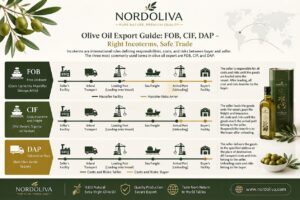
Olive Oil Export Incoterms: FOB, CIF and DAP — The Complete Guide for European Buyers 2026
One of the most consistently misunderstood topics in olive oil export and import is Incoterms selection. FOB, CIF, DAP or DDP — each term distributes costs, risks and responsibilities differently. Choosing the right olive oil export Incoterms saves a buyer between 100 and 150 euros per tonne on a single container, while the wrong choice produces unexpected customs costs and port delays. This guide compares the most relevant Incoterms for buyers importing Turkish olive oil into Europe in 2026.
What Are Incoterms and Why Do They Matter in Olive Oil Export?
Incoterms divide into two groups based on mode of transport. Seven terms apply to any mode — EXW, FCA, CPT, CIP, DAP, DPU and DDP — and four apply exclusively to sea and inland waterway transport: FAS, FOB, CFR and CIF. Olive oil export Incoterms selection determines three critical factors. First, who bears the risk if goods are damaged or lost in transit. Second, who pays for freight and insurance. Third, who handles customs clearance and import documentation. Tariffwise
For containerised olive oil shipments from Turkey to Europe, the most commonly used terms remain FOB, CIF and DAP. Understanding the difference between these three terms directly affects your landed cost.
FOB — Free on Board: Best for Experienced Buyers
Under FOB, the seller delivers goods on board the vessel at the named port of shipment. From that moment, all costs and risks transfer to the buyer, including ocean freight, cargo insurance, destination customs clearance and inland delivery. Suaid Global
Nordoliva FOB loading ports: Gemlik, İzmir or Istanbul
Who should choose FOB?
Experienced buyers with their own freight forwarder relationship typically find FOB costs less because the buyer controls the main carriage and can shop for the freight rate. FOB suits large-volume buyers who have established logistics networks and want full control over transport costs.
FOB advantages: Full price transparency at origin. Buyer controls freight and insurance. Competitive shipping rates achievable through buyer’s own network.
FOB disadvantages: All logistics coordination falls on the buyer. Damage risk transfers at the Turkish loading port. Buyer manages all customs processes at destination.
CIF — Cost, Insurance and Freight: For Port-Based Importers
Under CIF, the seller pays for ocean freight and minimum insurance to the destination port. This option suits buyers who want the seller to organise transport.
CIF price structure: Typically 5-8 percent above FOB price.
Who should choose CIF?
Buyers with their own customs agents at arrival ports who find port delivery sufficient. Large importers receiving direct containers into Rotterdam, Hamburg or Amsterdam commonly use this model.
CIF advantages: Freight organisation sits with the seller. Basic insurance included to destination port. Cost clarity to arrival port.
CIF disadvantages: CIF requires only minimum Clause C cover. For high-value extra virgin olive oil, additional all-risks insurance is strongly recommended, since oxidation or heat damage in transit can destroy the grade. Customs and post-arrival costs remain with the buyer.
DAP — Delivered at Place: The Practical Choice for Most European Buyers
For most B2B buyers under 100 tonnes per order, DAP delivers goods to the buyer’s warehouse with zero logistics complexity. DAP is the all-inclusive option with no hidden port fees.
DAP price structure: Typically 10-15 percent above FOB price.
Who should choose DAP?
Buyers who prefer not to manage logistics coordination and want warehouse delivery. Mid-sized German, Dutch and French buyers with their own customs agents commonly choose DAP.
DAP advantages: Seller organises all shipping. Delivery to buyer’s warehouse or named location. No freight surprises.
DAP disadvantages: Import duty and customs clearance remain the buyer’s responsibility. Total cost higher than FOB. Buyer must arrange a customs agent.
DDP — Delivered Duty Paid: Maximum Convenience, Maximum Cost
Under DDP, the seller bears all costs including customs duty and delivers to the buyer’s premises. This model appears attractive for buyers new to importing. However, under DDP the seller acts as importer of record, which is operationally complex in 2026 because the seller needs a customs bond and local tax presence.
Nordoliva, as an EU-registered exporter, works with experienced partners for DDP delivery to specific European markets. This option is available on request for established buyer relationships.
Olive Oil Incoterms Comparison Table
| Incoterms | Freight | Insurance | Customs | Risk Transfer | Best For |
|---|---|---|---|---|---|
| FOB Izmir | Buyer | Buyer | Buyer | On board vessel | Experienced high-volume buyers |
| CIF Rotterdam | Seller | Seller (min.) | Buyer | On board vessel | Port-based importers |
| DAP Hamburg | Seller | Seller | Buyer | Named destination | Most mid-sized buyers |
| DDP Warehouse | Seller | Seller | Seller | Buyer’s premises | First-time importers |
Containerised Shipments: FOB or FCA?
One of the most common errors in international trade is using FOB for containerised shipments. For containers, FCA is almost always the correct term — FOB assumes goods can be loaded directly onto a vessel, which is not how container logistics work. Tariffwise
Nevertheless, FOB remains widely used in olive oil trade by mutual agreement. Both Nordoliva and its buyers accept FOB terms where both parties understand the risk transfer point. The key rule is to always specify a precise location — for example, FOB Gemlik Port, Incoterms 2020 — to remove any ambiguity in the sales contract. Trans-road
Choosing the Right Olive Oil Export Incoterms by Buyer Profile
1-5 containers per year, mid-sized buyers: DAP is the most practical option. All logistics are managed by Nordoliva and the buyer handles only local customs.
Large importers with their own freight company: FOB Izmir or FOB Gemlik. Buyers optimise costs through their own shipping networks.
Buyers with port warehouses in Rotterdam or Hamburg: CIF suits this profile. Seller delivers to port and buyer manages storage and distribution independently.
First-time Turkish olive oil importers: DAP or DDP. This approach minimises logistics complexity on the first order and allows the buyer to learn the process.
Olive Oil Export Incoterms with Nordoliva
Nordoliva exports directly from Turkey’s finest olive-growing regions — Edremit, Ayvalık and Milas — to Europe under FOB Gemlik, FOB Izmir, CIF and DAP terms. As an EU-registered exporter, every shipment includes EUR.1 origin certificates, health certificates and full COA documentation. For wholesale buyers, visit our contact section for pricing and Incoterms options — our team responds within 24 hours. To explore our product range, browse the products section.
For the next step, read our guide on EUR.1 certificates and customs advantages → Nordoliva Insights
Sources: ICC Incoterms 2020 | CBI — European Olive Oil Market Entry Guide | Wikifarmer — Incoterms for Olive Oil